

Looking for docs on Bitbucket Data Center? See this doc.
Examples
Sync individual repos
Sync individual repos
{
    "type": "bitbucket",
    "deploymentType": "cloud",
    "repos": [
        "myWorkspace/myRepo"
    ]
}
Sync all repos in a workspace
Sync all repos in a workspace
{
    "type": "bitbucket",
    "deploymentType": "cloud",
    "workspaces": [
      "myWorkspace"
    ]
}
Sync all repos in a project
Sync all repos in a project
{
    "type": "bitbucket",
    "deploymentType": "cloud",
    "projects": [
        "myProject"
    ]
}
Exclude repos from syncing
Exclude repos from syncing
{
    "type": "bitbucket",
    "deploymentType": "cloud",
    // Include all repos in my-workspace...
    "workspaces": [
        "myWorkspace"
    ],
    // ...except:
    "exclude": {
        // repos that are archived
        "archived": true,
        // repos that are forks
        "forks": true,
        // repos that match these glob patterns
        "repos": [
            "myWorkspace/repo1",
            "myWorkspace2/*"
        ]
    }
}
Authenticating with Bitbucket Cloud
In order to index private repositories, you’ll need to provide authentication credentials via a token. You can do this using anAPI Token, Access Token, or App Password.
- API Token
- Access Token
- App Password
- Navigate to Personal Settings → API tokens and click Create API token with scopes. Give the token a name and set an expiry date.
- Select Bitbucket as the app.
-
Select the following scopes:
read:repository:bitbucket— View your repositoriesread:workspace:bitbucket— View your workspaces
- Click Create token and copy the token value.
-
Add the
user(your account email),gitUser(your Bitbucket username), andtokento your connection config. Learn why both are needed
{
    "type": "bitbucket",
    "deploymentType": "cloud",
    "user": "you@example.com",
    "gitUser": "myusername",
    "token": {
        // note: this env var can be named anything. It
        // doesn't need to be `BITBUCKET_TOKEN`.
        "env": "BITBUCKET_TOKEN"
    },
    // At least one of the following is required to specify which repos to sync:
    "repos": ["myWorkspace/myRepo"],
    // "workspaces": ["myWorkspace"],
    // "projects": ["myProject"]
}
- Pass this environment variable each time you run Sourcebot:
docker run \
    -e BITBUCKET_TOKEN=<API_TOKEN> \
    /* additional args */ \
    docker.sourcebot.dev/sourcebot-dev/sourcebot:latest
Create an access token for the desired scope (repo, project, or workspace). Visit the official Bitbucket Cloud docs
for more info.
- Add the
tokenproperty to your connection config:
{
    "type": "bitbucket",
    "deploymentType": "cloud",
    "token": {
        // note: this env var can be named anything. It
        // doesn't need to be `BITBUCKET_TOKEN`.
        "env": "BITBUCKET_TOKEN"
    },
    // At least one of the following is required to specify which repos to sync:
    "repos": ["myWorkspace/myRepo"],
    // "workspaces": ["myWorkspace"],
    // "projects": ["myProject"]
}
- Pass this environment variable each time you run Sourcebot:
docker run \
    -e BITBUCKET_TOKEN=<ACCESS_TOKEN> \
    /* additional args */ \
    docker.sourcebot.dev/sourcebot-dev/sourcebot:latest
App Passwords are deprecated. Atlassian recommends migrating to API tokens. Learn more
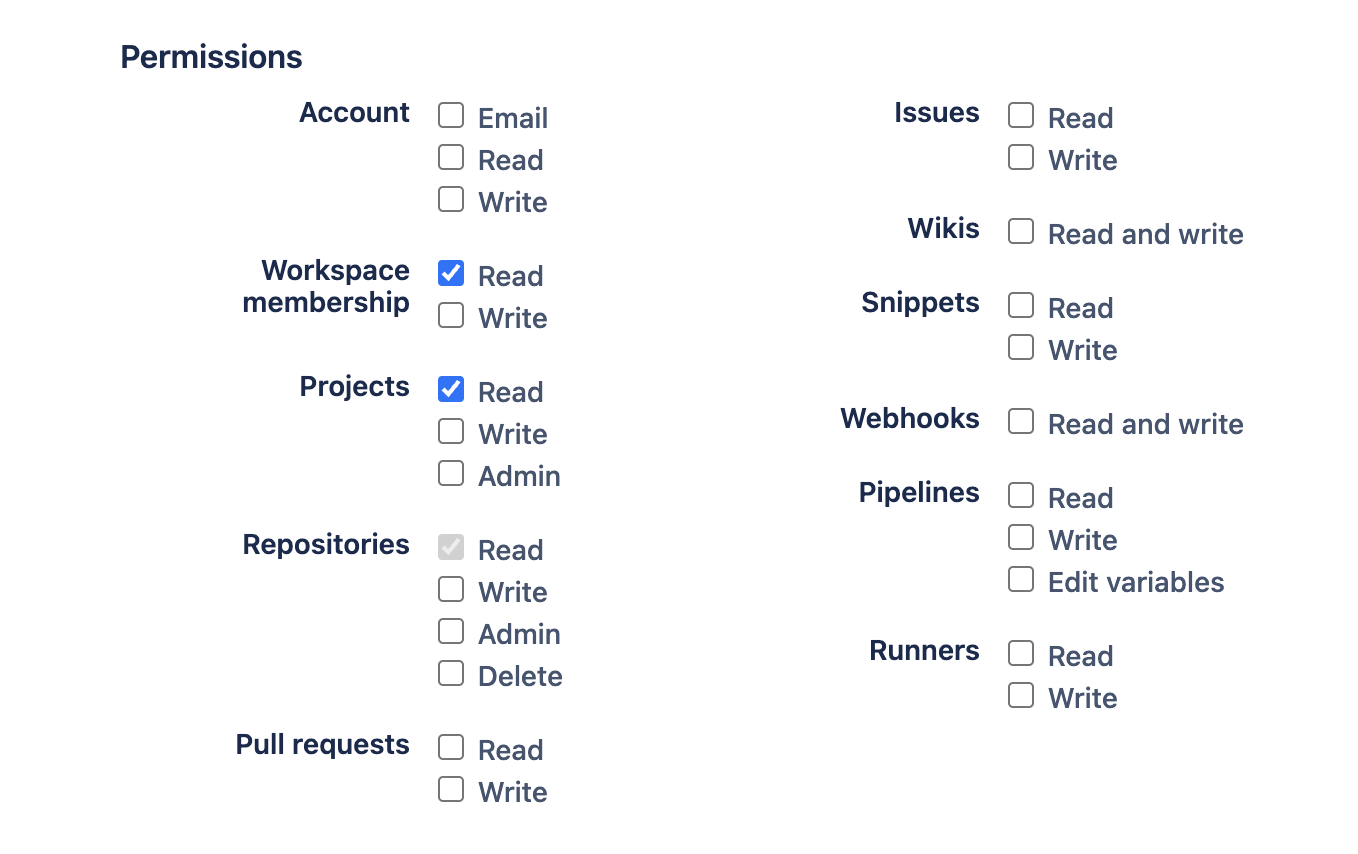
- Add the
user(your Bitbucket username) andtokenproperties to your connection config:
{
    "type": "bitbucket",
    "deploymentType": "cloud",
    "user": "myusername",
    "token": {
        // note: this env var can be named anything. It
        // doesn't need to be `BITBUCKET_TOKEN`.
        "env": "BITBUCKET_TOKEN"
    },
    // At least one of the following is required to specify which repos to sync:
    "repos": ["myWorkspace/myRepo"],
    // "workspaces": ["myWorkspace"],
    // "projects": ["myProject"]
}
- Pass this environment variable each time you run Sourcebot:
docker run \
    -e BITBUCKET_TOKEN=<APP_PASSWORD> \
    /* additional args */ \
    docker.sourcebot.dev/sourcebot-dev/sourcebot:latest
Schema reference
Reference
Reference
schemas/v3/bitbucket.json
{
  "$schema": "http://json-schema.org/draft-07/schema#",
  "type": "object",
  "title": "BitbucketConnectionConfig",
  "properties": {
    "type": {
      "const": "bitbucket",
      "description": "Bitbucket configuration"
    },
    "user": {
      "type": "string",
      "description": "The username to use for API authentication. For app passwords, this is your Bitbucket username. For API tokens, this is your Bitbucket account email address."
    },
    "gitUser": {
      "type": "string",
      "description": "The username to use for git clone authentication over HTTPS. If not set, falls back to 'user'. For API tokens, this is your Bitbucket username"
    },
    "token": {
      "description": "An authentication token.",
      "anyOf": [
        {
          "type": "object",
          "properties": {
            "env": {
              "type": "string",
              "description": "The name of the environment variable that contains the token."
            }
          },
          "required": [
            "env"
          ],
          "additionalProperties": false
        },
        {
          "type": "object",
          "properties": {
            "googleCloudSecret": {
              "type": "string",
              "description": "The resource name of a Google Cloud secret. Must be in the format `projects/<project-id>/secrets/<secret-name>/versions/<version-id>`. See https://cloud.google.com/secret-manager/docs/creating-and-accessing-secrets"
            }
          },
          "required": [
            "googleCloudSecret"
          ],
          "additionalProperties": false
        }
      ]
    },
    "url": {
      "type": "string",
      "format": "url",
      "default": "https://api.bitbucket.org/2.0",
      "description": "Bitbucket URL",
      "examples": [
        "https://bitbucket.example.com"
      ],
      "pattern": "^https?:\\/\\/[^\\s/$.?#].[^\\s]*$"
    },
    "deploymentType": {
      "type": "string",
      "enum": [
        "cloud",
        "server"
      ],
      "default": "cloud",
      "description": "The type of Bitbucket deployment"
    },
    "all": {
      "type": "boolean",
      "default": false,
      "description": "Sync all repositories visible to the provided `token` (if any) in the Bitbucket Server instance. This option is ignored if `deploymentType` is `cloud`."
    },
    "workspaces": {
      "type": "array",
      "items": {
        "type": "string"
      },
      "description": "List of workspaces to sync. Ignored if deploymentType is server."
    },
    "projects": {
      "type": "array",
      "items": {
        "type": "string"
      },
      "description": "List of projects to sync"
    },
    "repos": {
      "type": "array",
      "items": {
        "type": "string"
      },
      "description": "List of repos to sync"
    },
    "exclude": {
      "type": "object",
      "properties": {
        "archived": {
          "type": "boolean",
          "default": false,
          "description": "Exclude archived repositories from syncing."
        },
        "forks": {
          "type": "boolean",
          "default": false,
          "description": "Exclude forked repositories from syncing."
        },
        "repos": {
          "type": "array",
          "items": {
            "type": "string"
          },
          "examples": [
            [
              "cloud_workspace/PROJECT_KEY/repo1",
              "SERVER_PROJECT_KEY/repo2"
            ]
          ],
          "description": "List of specific repos to exclude from syncing."
        }
      },
      "additionalProperties": false
    },
    "revisions": {
      "type": "object",
      "description": "The revisions (branches, tags) that should be included when indexing. The default branch (HEAD) is always indexed. A maximum of 64 revisions can be indexed, with any additional revisions being ignored.",
      "properties": {
        "branches": {
          "type": "array",
          "description": "List of branches to include when indexing. For a given repo, only the branches that exist on the repo's remote *and* match at least one of the provided `branches` will be indexed. The default branch (HEAD) is always indexed. Glob patterns are supported. A maximum of 64 branches can be indexed, with any additional branches being ignored.",
          "items": {
            "type": "string"
          },
          "examples": [
            [
              "main",
              "release/*"
            ],
            [
              "**"
            ]
          ],
          "default": []
        },
        "tags": {
          "type": "array",
          "description": "List of tags to include when indexing. For a given repo, only the tags that exist on the repo's remote *and* match at least one of the provided `tags` will be indexed. Glob patterns are supported. A maximum of 64 tags can be indexed, with any additional tags being ignored.",
          "items": {
            "type": "string"
          },
          "examples": [
            [
              "latest",
              "v2.*.*"
            ],
            [
              "**"
            ]
          ],
          "default": []
        }
      },
      "additionalProperties": false
    },
    "enforcePermissions": {
      "type": "boolean",
      "description": "Controls whether repository permissions are enforced for this connection. When `PERMISSION_SYNC_ENABLED` is false, this setting has no effect. Defaults to the value of `PERMISSION_SYNC_ENABLED`. See https://docs.sourcebot.dev/docs/features/permission-syncing"
    },
    "enforcePermissionsForPublicRepos": {
      "type": "boolean",
      "default": false,
      "description": "Controls whether repository permissions are enforced for public repositories in this connection. When true, public repositories are only visible to users with a linked account for this connection's code host. When false, public repositories are visible to all users. Has no effect when enforcePermissions is false. Defaults to false. See https://docs.sourcebot.dev/docs/features/permission-syncing"
    }
  },
  "required": [
    "type"
  ],
  "if": {
    "properties": {
      "deploymentType": {
        "const": "server"
      }
    }
  },
  "then": {
    "required": [
      "url"
    ]
  },
  "additionalProperties": false
}